
After the release of 《Letters to Grandma》, we got into an argument over a bowl of Hokkien noodles.

Recently, "Letters to Grandma 《给阿嬷的情书》" has been showing in Singapore and Malaysia, with every screening sold out. A movie ticket encapsulates the shared memories of generations of Southeast Asian Chinese about their ancestors, remittance letters, and homesickness across the sea. The theaters are filled not only with the screen, but also with many people's deeply buried family stories—about ancestors who crossed oceans, about letters delivered through various channels, and about the taste of home pieced together from fragmented memories in foreign lands.
It was in this atmosphere that a video we released about making Hokkien noodles using Spoonx model-S cooking robot, unexpectedly sparked a heated discussion across multiple regions.
Video: https://www.youtube.com/watch?v=dSSrQn7xkvc (Cook Authentic Hawker Hokkien Mee Automatically | SpoonX Model-S)
One bowl of noodles, four cities, four "authentic" versions
The debate first erupted among our Malaysian colleagues.
A colleague from Kuala Lumpur shook his head, saying the noodles in the video were wrong—authentic Hokkien noodles should be thick yellow noodles stir-fried quickly over high heat with dark soy sauce, the sauce thickly coating each noodle, sprinkled with crispy pork lard, and simmered until semi-dry and semi-moist—that's the flavor that's been passed down in Petaling Street for nearly a century.

A colleague from Penang immediately countered, saying Hokkien noodles should be soup noodles. Shrimp shells are stir-fried and crushed, mixed with pork bones to create a rich and sweet broth, topped with a layer of clear red oil, served with yellow noodles, rice vermicelli, and water spinach, topped with a spoonful of sambal chili sauce—that's the authentic flavor passed down from the Hokkien immigrants near the Clan Jetties.

A colleague from Singapore added with a laugh, saying that where they're from, Hokkien noodles are stir-fried, with equal parts noodles and rice vermicelli, simmered in shrimp broth until the sauce thickens, and served with a slice of lime to cut the richness—a way of eating passed down from the old stalls in the Lorong Chuan area.

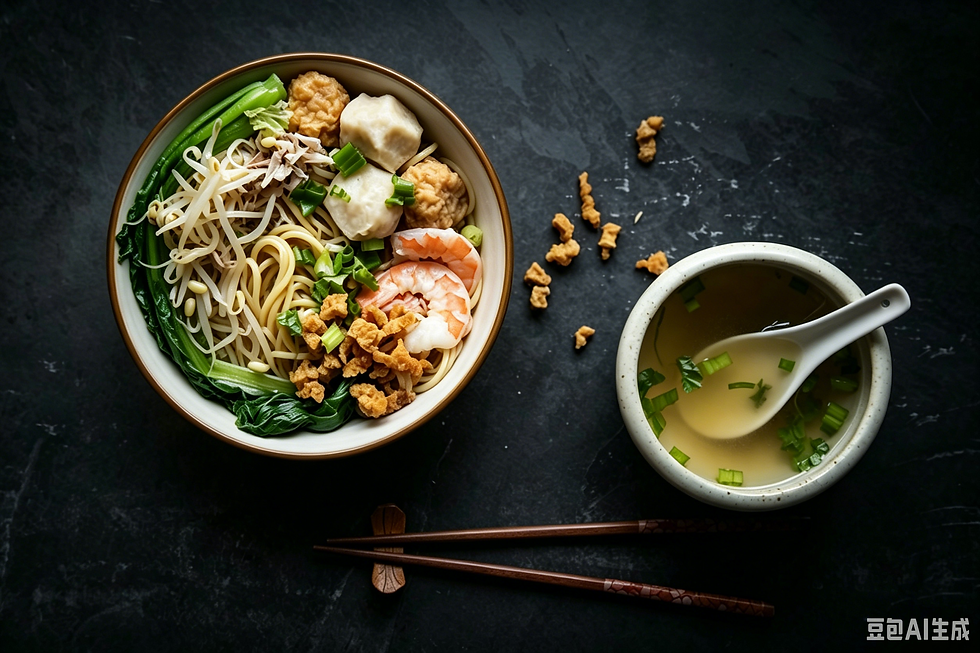
Even a colleague from Medan, Indonesia, joined the conversation. Their Hokkien noodles are typically dry-mixed, topped with braised pork belly, a braised egg, and fish balls, served with a bowl of clear soup—a familiar breakfast flavor for the descendants of Hokkien people in Sumatra.
Just as the discussion reached a stalemate, a colleague from Fujian quietly remarked:
"But in my hometown, there's never been a dish called 'Hokkien noodles.'"
That one sentence silenced the entire discussion.
Hokkien Noodles Only Truly Emerged After Leaving Fujian
Following this lead, we later discovered what is perhaps the most poignant paradox in Southeast Asian cuisine: noodles named after "Fujian" were actually created in Southeast Asia only after leaving Fujian province.
From the late 19th to the early 20th century, large numbers of early settlers from the Fujian coast traveled south by boat. People from different counties—Quanzhou, Zhangzhou, Xiamen, Anxi…—carried fragmented memories of their hometown flavors, settling on unfamiliar tropical islands. They couldn't replicate their complete hometown cuisine—the ingredients changed, the cooking utensils changed, and the pace of life changed. So some, drawn by the sweet taste of prawn noodles from memory, simmered the broth using locally abundant prawn shells and pork bones; others, to make the noodles more durable and filling, modified the soup noodles into dry noodles stir-fried with dark soy sauce; still others added local spices and chili to the soup noodles, adapting them to the tropical climate and palates.
Thus, Penang's soup noodles, Kuala Lumpur's fried noodles, Singapore's braised noodles, and Medan's dry noodles were born.
They are all called "Hokkien noodles," yet none can be found exactly in Hokkien itself. Because the word "Hokkien" was never just a recipe for a dish, but an anchor of identity. It's a way of life found by people far from their homeland in unfamiliar surroundings. Like the letters across mountains and seas in "Love Letters to Grandma," they express not only longing but also a message to themselves and future generations: where we come from.
No one is more authentic, only different branches growing from the same root
In the end, no one convinced anyone, but no one insisted on the word "authentic" anymore.
Many people like to argue for the orthodox origin of local food, as if only the earliest bowl counts. But the charm of immigrant cuisine lies precisely in the fact that it is never a static specimen. The early settlers who went to Southeast Asia didn't bring the flavors of their hometowns intact; what they brought was their understanding of food, their longing for their homeland, and their resilience in surviving hardship. Then these elements encountered the sunshine, rain, and ingredients of Southeast Asia, slowly growing into something new.
Penangites insist that soup noodles are the original flavor, Kuala Lumpurites prefer the wok hei (wok aroma) of stir-frying, Medanites are used to dry-mixed noodles with braised pork—these differences themselves are the most precious part of this cultural heritage. It shows that this bowl of noodles didn't die in a certain era; it lives, changes, and is loved by generations in different lands.
Just like the touching story of "Letters to Grandma," what resonates with us isn't a perfect hometown, but the connection that transcends time and distance, a connection that remains undiminished. Our ancestors crossed oceans, losing much, but also leaving much behind. Letters may moulder, accents may fade, even memories may become fragmented, but the warmth of a bowl of noodles, the essence of a flavor, will be unconsciously passed down from generation to generation.

Epilogue
Our initial intention in making the Hokkien noodles video was simply to demonstrate how a machine can recreate the wok hei (wok aroma) of street-side fried noodles. But this multi-location discussion made us realize that what we're truly doing is perhaps more than just replicating a dish.
When the robotic arm flips to add the ingredients, automatically adds seasonings, and controls the heat according to a pre-programmed rhythm, ensuring a bowl of Hokkien noodles is consistently cooked in kitchens across different cities, we are actually replicating a fragmented sense of nostalgia. It doesn't need to represent the "most authentic" flavor from any particular place; it simply needs to allow those who eat it to taste a familiar flavor—a flavor belonging to their ancestors and home—from that bite of sauce and the aroma of cooking.
That's enough.
After all, there's never a standard answer to the nostalgia of Southeast Asia.
It can be a love letter that crosses mountains and seas, a bowl of Hokkien noodles in various forms, or every attempt by our generation to continue passing down old flavors in new ways.
Keywords: Hokkien Mee cultural origin, Letter to Grandma movie Hokkien Mee, Southeast Asian Hokkien noodle heritage
#LetterToGrandma #LetterToGrandmaMovie #NanyangNostalgia #OverseasChineseStory #HokkienMee #HawkerFoodCulture #NanyangCuisine #WokHei #FoodHeritage #CulturalRoots #ImmigrantFoodStory
AI-Generated Image Disclaimer: Some images on this blog are marked with "豆包AI生成". These images are provided for illustrative purposes only, to help readers better visualize the dishes and scenarios described in the written content. AI-generated images may objectively differ from actual dishes and real scenes. They are for reference only and do not constitute any product promise or consumption advice. Please refer to the written descriptions for accurate information.
Comments